But in all seriousness, I will be leaving for Paraguay in one month to join the Peace Corps as a community health and youth development volunteer!!! Don't worry if you have no idea what that means, to be truly honest neither do I. But I hopefully can answer some of the most common questions that people have asked me thus far. And obviously keep them coming. The more I talk about it the more excited I get!
Frequently Asked Preguntas:
1) Where is Paraguay?
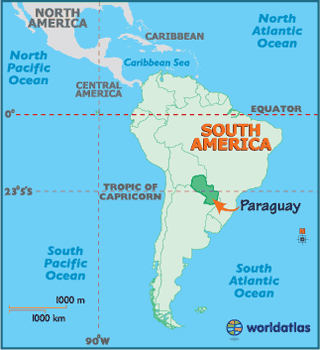
2) What language do they speak?
Spanish is the language of business and Guarani is the language of friendship. So, if I have any hope of finding a novio, Guarani is the language I will learn. And to just get it out in the open...no, I don't speak Spanish. I try... and fail. But hopefully that will change if I have any hope of not being made fun of without realizing it everywhere I go.
3) Where will you be living?
No clue. That's a lie. I know that I will be in a town called (can't remember right now, I'll update this later) about 45 minutes outside the capital of Asuncion for training. But after that you know as much as I do. Good thing I like surprises.
About 80 percent of Volunteers live in small towns or villages with fewer than 5,000 people, and some of these campo (countryside) sites have fewer than 200 inhabitants. Most (but not all) have electricity, as the country has increased the availability of electricity from 24 percent of Paraguay’s 3 million people in 1978 to more than 60 percent of the current population of about 6.2 million. Generally, streets in the campo towns are unpaved, and there is no running water or indoor toilets. Few people in these towns have traveled outside Paraguay, and many have never even been to Asunción. The only people with cars are likely to be the doctor, the priest, and a few business people, government officials, and ranchers. Horses, motorcycles, bicycles, and ox carts make up the majority of local traffic, with children playing freely alongside roaming cows, pigs, and chickens.
For both rural and urban Volunteers, housing in Paraguay is basic. Volunteers are required to live with a Paraguayan family during their initial three months of service. Some Volunteers then choose to live alone in one- or two-room wood or brick homes; others choose to live with a Paraguayan family for their entire two years of service.
4) What will you be doing?
I fly down to Paraguay with approximately 20 other Americans all in the same program as me and participate in a 10 week training program through the Peace Corps. I'll get language training, safety training, project ideas, get acquainted with the culture, learn about community issues, etc. Then I start my service in a community in Paraguay for two years working on a variety of primary health care projects, such as hygiene and sanitation, nutrition, dental health, sexual and reproductive health, HIV and STIs and maternal and child care. The sector is aimed at helping local communities to improve their health status by providing education and training to health personnel, teachers, children and families.
5) What do you eat?
Paraguayans tend to eat more simple meals than people do in the United States. Dietary habits and the lack of agricultural diversity often limit meals to beans, rice, noodles, meat (when available), corn, onions, tomatoes, and manioc. Manioc, or mandioca (more commonly known in other countries as yucca or cassava), is the staple food in rural Paraguay and is as ubiquitous at the table as bread is in other countries.
6) When can I talk to you?
During training I'll be pretty busy with limited internet access and I get a Paraguayan cell phone but it's pretty much limited to talking to other volunteers, host families, etc from what I understand. But when I begin my service I might have more time to talk via internet depending on the signal and which community I get placed in. So all up in the air but snail mail people! I would LOVE it! I'll send you the address soon! And hopefully I'll be able to update this somewhat regularly! Also, plan your visits now because I get three weeks of vacation a year so come visit!!
7) What are you most nervous about?
I've heard that Paraguayan birthdays are a BIG deal and that in Paraguay people throw their own parties. I'm not normally a crazy birthday person with extravagant parties so this is a stress to me. So, the fact that I will be only one week into my community when my birthday comes and I'm expected to throw a party for the entire community is stressing me out. I'm sure you'll hear more about this soon!
8) What are you most excited about?
The munchkins!!! And learning a new language. I love it.
That's all I can really think of for now and this post is wicked long. And a lot of it's plagiarized from my welcome book because I have no idea what I'm getting into really. But I kind of like it that way, free of expectations. I'm gonna miss my crazy cool San Diego life soooooooooo much, but I also feel 98% ready to start this adventure. The other 2% of me would rather surf and eat unlimited burritos in San Diego the rest of my life and be completely happy with it. Anyway, that's all for now. Wish me luck in my international novio hunt, I'll need it!

Hahaha I was going to ask you if you copy/pasted this from wikipedia bc I've never heard you use the word "ubiquitous". I'm not re-reading these posts because I miss you, so just get over yourself. Love you! -Em
ReplyDelete